

Fingrid’s climate impact
Fingrid contributes to climate change mitigation by building and maintaining the main grid, developing the electricity market and designing new flexible market solutions. Fingrid’s business generates a positive system-level climate impact – the climate benefit – by enabling the connection of clean electricity production and consumption to the main grid and by facilitating the electrification of industrial processes and energy production in Finland. As part of its corporate ESG targets, Fingrid is aiming for significant, science-based reductions in greenhouse gas emissions from its own operations over the next five years. The negative carbon footprint impacts of Fingrid’s operations are significantly smaller than the indirect climate benefit driven by the company at the system level.
From a sustainable development perspective, the most impactful aspect of Fingrid’s climate work is the positive impact – the climate benefit – created by the company through its business. The EU’s Sustainable Finance Taxonomy also defines the transmission of electricity as an enabling activity with which other sectors’ greenhouse gas emissions can be significantly reduced. Fingrid’s activities contribute to enabling the green transition and support the implementation of Finland’s National Energy and Climate Strategy. In addition to the implementation of Fingrid’s extensive investment programme, the company promotes the most efficient use of the existing grid in a number of ways, reducing the need for new transmission lines. The long-term electricity system vision for Fingrid’s main grid is based on the achievement of Finland’s climate targets and the low-carbon roadmaps of different industries.
Every year, wind and solar power production is connected to Fingrid’s main grid and new connection agreements are signed for these forms of electricity production. Connecting clean energy production to the grid will indirectly enable the avoidance of significant greenhouse gas emissions in the future. This is because the electricity system of Finland still includes green house gas-emitting forms of production, which are being replaced by clean electricity production. Fingrid’s positive climate impact and role in enabling the clean transition is indicated by the real-time emission factor for the electricity consumed in Finland. As part of our corporate ESG targets, we have set an emission factor target of 17 g CO2/kWh by 2030. We strive to reach this target in cooperation with our customers. In 2025, the average real-time emission factor for the electricity consumed in Finland was 26 g CO2/kWh. The developments of the emission factor can be followed on the Fingrid Open Data website.
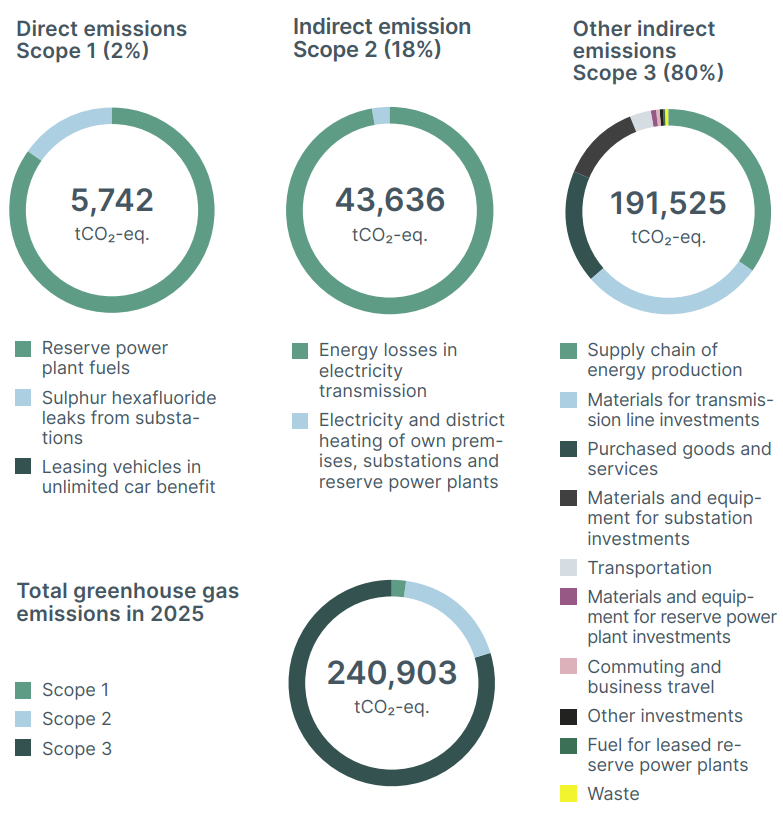
When we make investments in the main grid to enable the transition to a clean electricity system, we also nevertheless cause greenhouse gas emissions. Fingrid’s greenhouse gas emissions (scope 1–3) in 2025 totalled 240,903 tonnes of carbon dioxide equivalent. Total greenhouse gas emissions decreased 4 per cent compared to the previous year.
The greenhouse gas emission intensity of Fingrid’s main grid* relative to the amount of electricity transmitted has decreased significantly in recent years. In 2025, the greenhouse gas emission intensity was approximately 65% lower comparad to the 2020 level.
|
Year |
Greenhouse gas emission intensity g CO2-eq/kWh |
|
2020 |
1.7 |
|
2021 |
2.0 |
|
2022 |
1.5 |
|
2023 |
0.9 |
|
2024 |
0.8 |
|
2025 |
0.6 |
The indirect greenhouse gas emissions from the materials and equipment used in the construction of the network comprise our main sources of emissions. The production of steel and aluminium in particular increases the carbon footprint of the material and product phase. Greenhouse gas emissions from grid construction materials constitute a 'carbon peak' at the time of project completion, even though main grid structures will last for several decades. Other indirect emissions are caused by, for example, procurement, waste, commuting and business travel.
A considerable proportion of the company’s carbon footprint consists of emissions from the production of the electricity acquired from the electricity market to replace power losses taking place during electricity transmission. However, as the amount of clean energy production in the electricity system increases, the carbon footprint from energy lost during grid transmission is reduced.
In addition, greenhouse gas emissions are caused when reserve power plants are activated during severe disturbances in the electricity system and if sulphur hexafluoride (SF6), a powerful greenhouse gas contained in substation equipment, is released into the atmosphere. The annual SF6 leakage rate has been very low over the long term, averaging less than 0.2 per cent.
Fingrid is committed to significant greenhouse gas emission reductions and has received the endorsement of the Science Based Targets initiative (SBTi)** for its targets. With our science-based short-term targets, we commit to reducing, by 2030, our absolute direct greenhouse gas emissions (scope 1) by 42 per cent from the level of the base year 2022. The target for reducing indirect greenhouse gas emissions (scope 2) is 53 per cent. These targets are in line with the rate of emission reductions that have been found sufficient to limit the global temperature increase to 1.5°C compared to pre-industrial levels. Fingrid is committed to reducing other indirect emissions (scope 3) by 25 per cent by 2030 compared to the levels of 2022.
Key measures to achieve the emission reduction targets include the purchase of aluminium conductors produced with fossil-free electricity and the switch to renewable diesel for reserve power generation, which is currently being explored. In 2025, a study looking into the need for technical changes to reserve power plants was initiated, and a test site was planned for 2026. In addition, the suitability of low-carbon concrete for transmission line foundation elements was piloted, and follow-up actions were assessed based on a trial in which low-emission recycled steel structures were procured for three new substations. Going forward, Fingrid will also explore ways to improve material efficiency in grid construction in order to reduce the consumption of steel and concrete. Fingrid has drawn up a roadmap for SF6-free technology, which outlines the principles and targets for the introduction of SF6-free technology at Fingrid’s substations. All measures to reduce greenhouse gas emissions are compiled in a company-level action plan. Successful emission reduction measures require close cooperation with contractors and other partners committed to climate change mitigation.
At the company level, we report on our carbon footprint, progress on emission reduction measures and indirect climate benefits in our statutory sustainability statement.
At the project level, the climate impact of Fingrid’s transmission line investments are assessed as part of the statutory environmental impact assessment. In this context, the most significant impacts to be assessed derive from the materials required for transmission line construction and the impact of removal of trees from transmission line areas and clearings under the transmission lines on carbon pools and sinks.
* Fingrid’s total direct (scope 1) and indirect (scope 2) emissions divided by the amount of electricity transmitted in the main grid.
** Science Based Targets is a collaborative initiative of the CDP, the UN Global Compact, the World Resources Institute (WRI) and the World Wide Fund for Nature (WWF). The initiative defines and promotes best practices in setting science-based targets and independently assesses companies’ targets.